
Dental Crowns & Bridges: Restoring Strength, Function, and Smile Balance
August 14, 2026 9:00 amA tooth can reach the point where a filling is no longer enough. Maybe there is a large old filling with only a thin shell of tooth left around it, a crack that hurts when you bite something firm, or a tooth that has already been repaired several times and is starting to feel unreliable. In other cases, the tooth is already missing, and you have gotten used to chewing around the space even though it is not ideal.
At Windmill Dental in Amarillo, TX, Dr. Austin A. Whetten uses crowns and bridges to rebuild those areas in different ways. A crown covers and protects a tooth that is still there, while a bridge replaces one or more missing teeth by spanning the open space. Both restore chewing function, and both are designed to blend naturally with the surrounding teeth.
So, the first thing we look at is what the area actually needs. Sometimes a tooth still has enough healthy structure to protect with a crown. Other times, the tooth is already gone, and then the bigger question is how to replace the space without creating new problems for the teeth around it.
What Is a Dental Crown?
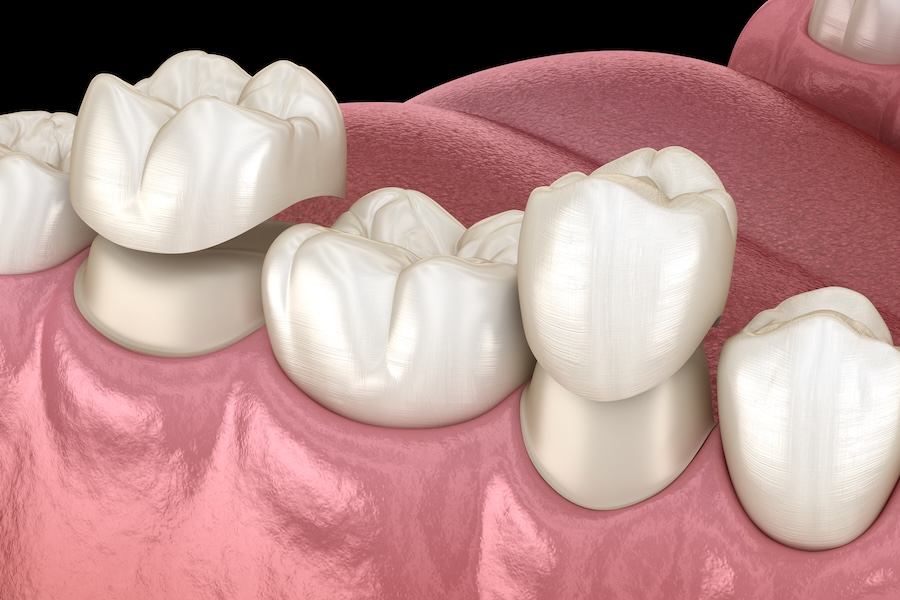
A dental crown is a custom restoration that covers a damaged or weakened tooth. It is shaped to look and function like a natural tooth, then cemented over the remaining tooth structure. Once it is in place, the crown becomes the surface you bite and chew with.
Crowns are commonly used when a tooth has a large filling, a significant crack, heavy wear, or damage that leaves too little support for another filling. They may also be recommended after root canal treatment when the tooth needs more protection. In each case, the crown wraps around the remaining structure and helps hold it together.
Dr. Whetten also looks at where the tooth is and how much pressure it takes. A back molar spends its days grinding through sandwiches, steak, chips, and everything in between, so it needs a restoration that can handle that workload. A crown near the front has less heavy chewing to do, but its shape and appearance become much more noticeable when you smile.
When a Crown May Be Needed
Sometimes part of the tooth has already broken away. Other times, the tooth is still intact but gives you a sharp twinge when you chew, or an old filling has become so large that there is not much natural tooth left around it. You may also notice a rough edge or a spot that your tongue keeps finding.
Large fillings are a common reason crowns are recommended. Over the years, a tooth can be repaired more than once, and each new filling may leave less natural structure behind. Eventually, replacing the filling again may not give the tooth enough support for regular chewing.
A crown can cover those weakened walls and spread biting pressure across the restoration. Dr. Whetten can show you where the tooth has thinned, cracked, or lost support and explain why another large filling may not hold up as well. Seeing how much solid tooth remains can help you understand why the treatment has changed.
What Is a Dental Bridge?
A dental bridge replaces one or more missing teeth with a fixed restoration. A traditional bridge usually uses crowns on the teeth beside the gap to support the replacement tooth in between. Once the bridge is cemented in place, it stays in your mouth.
That can help if a missing tooth has started changing the way you eat. Maybe food keeps packing into the space, or you have been sending everything crunchy to the other side for so long that you do it automatically. A bridge gives that side of the mouth another chewing surface again.
It can also restore the appearance of a missing tooth, especially if the gap shows when you smile or speak. At the same time, however, the bridge needs to fit the bite correctly and be practical to keep clean. If it looks good but feels awkward when you chew, it still needs attention.
Crowns and Bridges Do Different Jobs
A crown is used when the tooth is still present but needs more protection. A bridge is used when a tooth is missing and the space needs to be replaced. The two treatments often overlap because a traditional bridge uses crowns on the teeth beside the gap.
For example, a cracked molar may still have enough healthy structure to save, so Dr. Whetten may recommend a crown. But if the crack extends too far and the tooth cannot be restored, extraction may be necessary. Then, replacing the missing tooth becomes a separate decision.
Sometimes the neighboring teeth already need crowns because of large fillings, cracks, or older dental work. In that case, a bridge may address the missing tooth while also restoring the teeth beside it. If those neighboring teeth are healthy and untouched, though, an implant may be worth comparing before they are reshaped for crowns.
The Teeth Beside a Bridge Need a Close Look
A traditional bridge depends on the teeth beside the gap for support, so Dr. Whetten will examine them carefully. One may be completely healthy, while the other already has a large filling or crown. Their condition can push the plan in one direction or another.
If both teeth already need crowns, using them to support a bridge may fit well with treatment they need anyway. But if they have never had much dental work, preparing them for crowns is a bigger decision. In that situation, leaving those teeth alone and replacing the missing tooth with an implant may make more sense.
The gums and bone around the supporting teeth also need to be healthy. A loose tooth or one with significant gum disease may not be a good anchor for a bridge. So before asking those teeth to carry extra work, we want to know they have solid support underneath.
How a Crown Protects a Weak Tooth
When a tooth has a large filling or crack, the remaining walls can become thin. Those sections may flex under chewing pressure, and eventually one can break away. It does not always take a dramatic bite either; sometimes a perfectly ordinary piece of toast is the one that finishes the job.
A crown surrounds the weakened tooth and helps hold those walls together. It also rebuilds the chewing surface so the tooth can meet the teeth above or below it more evenly. For a back tooth that does a lot of grinding and crushing, that coverage can be a better fit than another large filling.
Then, once the crown is in place, Dr. Whetten checks the bite carefully. If the crown sits a little too high, you may feel like that tooth hits first every time you close. A small adjustment can make the tooth settle back into your bite much more comfortably.
How a Bridge Helps With Chewing
When a tooth is missing, people often adjust without realizing it. You may chew more on the opposite side, cut certain foods smaller, or avoid letting tougher foods land near the gap. Eventually, you may catch yourself switching sides before you have even taken the first bite.
A bridge restores a chewing surface in the missing area. That lets the teeth on that side take part again instead of leaving more of the work to the other side. With a missing back tooth, you may notice the improvement most when you go back to foods that used to make you change sides.
Dr. Whetten also checks how the replacement tooth meets the opposing teeth. If it hits too hard, the bridge can feel uncomfortable and the supporting teeth may take more pressure than they should. Once the bite is adjusted, the bridge should feel even when you close, chew, and move your jaw.
Missing Teeth Can Let Other Teeth Shift
Teeth tend to hold their positions partly because of the teeth beside and across from them. When one tooth is lost, nearby teeth may gradually lean or drift toward the open space. Meanwhile, the tooth above or below the gap may also begin moving because it no longer has anything to meet.
Those changes usually happen slowly, so you may notice the effects before you notice the movement itself. Food may start catching differently, or the bite may not feel quite the same as it used to. If the space has been open for years, Dr. Whetten will look at how much room is still available for a replacement.
A bridge can fill the space and help prevent more drifting once it is in place. However, if the teeth have already moved quite a bit, the area may need some extra planning first. Sometimes the space that looked wide enough years ago is not the same space anymore.
What Happens During Crown Treatment?
For a crown, Dr. Whetten first removes any decay or damaged material and shapes the remaining tooth so the restoration can fit over it. Next, impressions or digital scans are taken to record the tooth, the neighboring teeth, and the bite. Those records are then used to make the final crown.
A temporary crown is usually placed while the final restoration is being made. It protects the prepared tooth and lets you use the area in the meantime, although very sticky foods can pull a temporary loose. If you are a caramel person, this is probably the week to give them a break.
When the final crown is ready, Dr. Whetten checks the fit, the contact with the neighboring teeth, and the bite before cementing it in place. If one area feels high, it can be adjusted before you leave. Once the numbness wears off, the crown should feel like it belongs with the rest of your teeth.
What Happens During Bridge Treatment?
For a traditional bridge, the teeth on either side of the gap are prepared for crowns. Those teeth act as the anchors for the replacement tooth between them. Next, impressions or digital scans are taken so the bridge can be made to fit the space and your bite.
A temporary bridge is often placed while the final one is being made. It keeps the prepared teeth covered and fills the gap in the meantime. While it is there, go easy on chewing gum, taffy, and anything else that likes to hang on when you bite down.
Then, at the final visit, Dr. Whetten checks how the bridge fits against the gums, how the replacement tooth looks, and how the bite feels. Small adjustments can be made before the bridge is cemented. After that, it stays in your mouth and becomes part of your normal chewing routine.
How Crowns and Bridges Can Blend In
Today’s crowns and bridges are made with tooth-colored materials that can be matched closely to the surrounding smile. Near the front of the mouth, the small details become much easier to see, including shade, translucency, contour, and the shape of the biting edge. Those are the details Dr. Whetten looks at when he is trying to make the restoration disappear into the teeth around it.
Surprisingly, making a tooth look too perfect can make it look less natural. Real teeth have tiny shifts in color, soft changes in translucency, and slightly different contours from one tooth to the next. An excellent restoration picks up those natural variations instead of turning the tooth into a smooth, identical copy of its neighbor.
So a front crown may need a softer edge, a little more translucency near the tip, or a contour that follows the character of the rest of your smile. Dr. Whetten is especially attentive to those small visual details because they are often what separate a crown that looks like dental work from one that simply looks like a tooth.
How to Clean Around Crowns and Bridges
A crown is brushed and flossed much like a natural tooth. The crown itself cannot develop a cavity, but the tooth underneath still can, especially near the edge where the restoration meets the tooth. Keeping that area clean helps protect the structure supporting the crown.
With a bridge, regular floss cannot pass straight down between the connected teeth. Instead, the area underneath the replacement tooth needs to be cleaned with a floss threader, interdental brush, or another tool that can reach below it. That keeps plaque and food from sitting around the supporting teeth and gumline.
Some people prefer a threader, while others do better with a small brush, especially if there is a little more room underneath. Once you find the tool that feels easiest in your hands, the process usually becomes much quicker. The key is making sure that hidden space under the bridge does not become the one place that gets skipped.
How Long Do Crowns and Bridges Last?
Crowns and bridges can last for many years, but they still deal with the same chewing forces, plaque, and wear as the rest of your teeth. The health of the supporting teeth, gum condition, bite pressure, cleaning habits, and the size of the restoration all affect how well they hold up.
Grinding and clenching can be hard on dental work. If you wake up with a tired jaw, notice flattened tooth edges, or have chipped crowns or fillings before, tell Dr. Whetten. A nightguard may be recommended to reduce some of the pressure the restorations take while you sleep.
Regular dental visits also give us a chance to check the edges of crowns and bridges, the gums around them, and the teeth underneath. A restoration can feel completely normal while a small area of wear or decay is starting around one edge. Finding that early usually leaves us with more options.
When a Tooth Cannot Be Saved With a Crown
Sometimes there is not enough healthy tooth left to support a crown. A crack may extend too far below the gumline, decay may have destroyed too much structure, or the tooth may have broken in a way that cannot be rebuilt predictably. In those cases, extraction may be the better option.
If the tooth needs to come out, Dr. Whetten can explain what can be done with the space afterward. A bridge may be one choice, while a dental implant or removable partial denture may also be considered. The nearby teeth, available bone, bite, and your preferences all help narrow those choices.
This is one reason it is worth having a tooth checked when it starts feeling different instead of waiting for a larger piece to break. If there is still enough strong structure, a crown may be able to protect it. Once too much of the tooth is gone, however, the options can shrink pretty quickly.
Bridge or Dental Implant?
If a tooth is already missing, a bridge and a dental implant may both be possible, but the condition of the teeth around the space usually helps narrow the choice first. A traditional bridge uses those neighboring teeth for support, while an implant stands independently in the jawbone and supports its own crown. So if the teeth beside the gap are already heavily restored, they may fit naturally into a bridge plan.
Now take the opposite situation. If both neighboring teeth are healthy and have never needed crowns, preparing them for a bridge means removing healthy tooth structure that would otherwise stay untouched. In that case, an implant may be more appealing because those teeth can remain as they are.
Next comes the treatment process. A bridge can usually be completed sooner because there is no implant surgery or healing period in the bone. An implant takes more time, and there still needs to be enough bone at the site to support it, but once it is restored, it does not depend on the teeth beside it.
Then there are the practical differences at home. With a bridge, you clean underneath the connected replacement tooth, while a single implant crown is cleaned more like an individual tooth. However, both still need regular brushing, flossing, and dental visits, so the difference is really about which routine fits you better.
Cost, surgery, healing time, bone availability, and maintenance all come into the decision too. By then, though, the comparison is much more specific to your mouth rather than a generic bridge-versus-implant list. Dr. Whetten can walk through both if either one is realistic for the space.
Dental Crowns and Bridges at Windmill Dental in Amarillo, TX
If you have a cracked tooth, a large old filling, or a missing space that you have been chewing around for years, come see us at Windmill Dental in Amarillo. Dr. Austin A. Whetten can examine the tooth, neighboring teeth, gums, and bite and explain whether a crown, bridge, or another option fits what is happening. Sometimes we are protecting a tooth that still has plenty of life left in it, while other times we are figuring out the best way to replace one that is already gone.
Tell us what you have been noticing at home too. Maybe one tooth only complains when you bite into something firm, an old filling has started catching your tongue, or food heads straight for the same missing space at every meal. Those everyday details can help Dr. Whetten zero in on what needs attention.
If you are considering a crown or bridge, schedule a visit with Windmill Dental in Amarillo. We can take a closer look, explain what the tooth or missing space needs, and help you choose a restoration that works comfortably with the rest of your bite. We’d be happy to welcome you in and help get that part of your mouth working the way it should again!
Categorized in: Dental Bridges, Dental Crowns